
Somewhere between the nine grahas and the transits, classical astrology keeps a second layer of points: the upagrahas — "sub-planets" that have no physical body and no orbit, but which the older texts use without apology. The most famous of them is Gulika, also called Maandi.
The classics are unambiguous about its status. The Brihat Parashara Hora Shastra names Gulika's other name — Maandi — in a single line, and generations of traditional astrologers have called it the most malefic entity in a chart: more testing, degree for degree, than any natural malefic. Yet if you open almost any app today, you will not see it. There are reasons for that, and they are worth understanding before you take the concept seriously.
What Gulika is
Gulika is not a body — it is a segment of time. Each day is divided into eight equal parts from sunrise to sunset, and each part is assigned to the lord of a weekday in order. The eighth part has no lord. For night births, the same eightfold division is applied from sunset, starting with the weekday that falls fifth from the birth weekday. The segment belonging to Saturn — the slow, heavy, exacting planet — is called Gulika, and the ascendant rising at that segment's start gives Gulika's position in the chart.
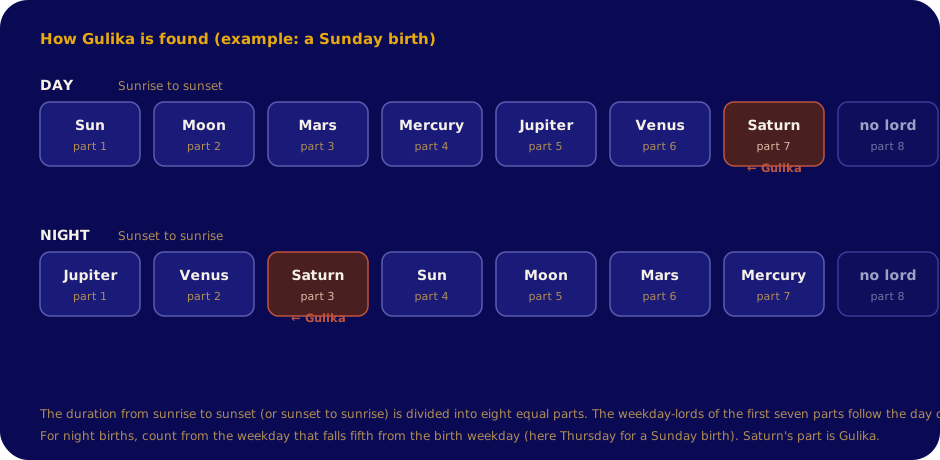
This is why the upagrahas feel strange to modern eyes: Gulika exists only as a function of the moment of birth and the day of the week. Change the birth time by twenty minutes and Gulika's segment shifts. It is time itself, personified.
Why the tradition valued it
In the classical system, Gulika was not an optional extra — it was part of the standard toolkit. The Gulika-kundali, a chart reckoned from Gulika's position instead of the ascendant, used to be drawn on every traditional janma-patri alongside the main chart. The texts give it a surprisingly complete set of rules:
- Houses: Gulika in the 3rd, 6th, 10th, or 11th house is said to give good results — the classical "upachaya" houses, where friction produces growth. Elsewhere it afflicts: in the 1st it reduces the strength of the whole chart, in the 2nd it curtails family comfort and savings, in the 4th social standing suffers, in the 5th trouble with children, and so on. In the 10th it delays career establishment even while supporting it.
- Conjunctions: Gulika joined with a natural significator is said to spoil that significator's gifts — with the Sun, difficulties for the father; with the Moon, for the mother; with Mars, for siblings; with Venus, trouble in marriage; with Jupiter, hypocrisy; with Saturn, disease and skin trouble.
- The degree matters: when the ascendant's degree and Gulika's position coincide closely — birth at the very start of Gulika's segment — the affliction is said to be at its maximum, dampening even powerful raja yogas.
The controversy the texts themselves admit
Here is where Gulika becomes a lesson in how tradition actually works. The calculation is disputed in the classics themselves. The Parashara verse says the position is taken from the beginning of Saturn's segment — but a well-known alternate method uses the end of the segment, and the popular "ghati-table" method (a fixed table of hours for each weekday) is a shortcut that the careful commentators explicitly call inaccurate. Depending on which method a tradition follows, Gulika can sit in a different sign for the same birth.
That is a red flag, and an honest one. The concept is classical; the exact method is one of the genuinely unresolved corners of the tradition. This is why modern software that does display Gulika usually adds a settings toggle for the method — and why two astrologers using different schools can genuinely disagree about where it falls.
Where we stand
We have made a deliberate choice at NativeAstro: we do not display Gulika in our charts by default. Not because the concept is false — it is thoroughly classical — but for three reasons that fit how we practise:
- It demands a precise birth time. Gulika's segment shifts with the birth minute. Most people do not know their exact birth time, and for them Gulika is not a data point — it is noise. Chart rectification exists precisely because birth times are rarely exact.
- The method is genuinely disputed. When the classical texts disagree about how to find a point, presenting one method as fact would be overstating our certainty. We prefer to name the disagreement.
- Its most famous uses are fatalistic. In the older literature, Gulika's headline applications are longevity, maraka (death-inflicting) periods, and accident prediction. Those belong to a clinical style of astrology we deliberately do not practise. Our readings are for living your chart well, not for predicting endings.
None of this is a rejection. If your birth time is exact and you work with a traditional astrologer who uses Gulika — and many excellent ones do — the point may genuinely refine the reading. What we refuse to do is present a disputed, time-sensitive shadow-point as if it were a certainty printed in stone.
The lesson of Gulika, in the end, is a meta-lesson: the tradition is vast, and even its own texts argue with themselves. A good astrological system knows both what it includes and what it leaves out — and why.