
The daśā system is astrology's calendar of the soul: the planet-by-planet timeline that says which graha's energy is operating during which stretch of your life. Vimśottarī — the 120-year cycle based on the Moon's nakshatra — is the one everyone knows, and the one we use for every reading at NativeAstro.
But a visitor to the tradition quickly discovers that Vimśottarī is not the only clock. Classical and medieval texts describe dozens of daśā systems, each with its own length, its own base point, and its own school of devotees. If you have ever wondered whether you are "missing" something by reading only Vimśottarī, this article is the honest answer.
The landscape of the clocks
Vimśottarī (120 years). The great cycle of the nine grahas — Ketu through Venus — in periods of 7 to 20 years, keyed to the Moon's nakshatra at birth. It is the daśā Parāśara gives the most space to, and the one that has survived as the workhorse of the tradition. Every chart we draw runs on it.
Aṣṭottarī (108 years). A nine-planet cycle keyed to the Sun's nakshatra, with a different ordering and shorter periods. The classical texts suggest it for specific birth conditions — traditionally, night births in the bright fortnight or day births in the dark fortnight.
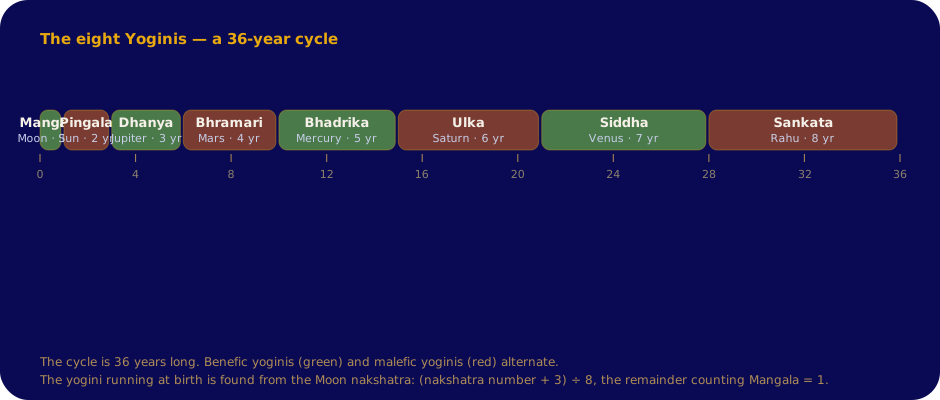
Yoginī (36 years). A short, elegant cycle of eight "Yoginīs" — divine feminine energies, each lorded by a planet and each lasting one to eight years. It is calculated from the Moon's nakshatra with a simple formula: add 3, divide by 8, and the remainder names the running Yoginī. The Rudrayamala, a tantric text, praises it as the daśā of the Kali Yuga — swift, direct, and startlingly accurate in its results.
Chāra (Jaimini). The sign-based daśā of the Jaimini school, which abandons the planets entirely and moves from sign to sign, paced by the strength of the signs in the chart. It requires a completely different interpretive lens — Jaimini's karakas, arudhas, and argala — and rewards astrologers who master it.
Nārāyaṇa, Kālachakra, and the rest. The tradition's full inventory includes dozens more — Nārāyaṇa daśā (a sign-cycle with house-by-house steps), Kālachakra (a vast 360-year wheel), Shoola, Drigdasha, and others. Each is a complete system with its own literature and its own loyalists.
Why the tradition has so many
This is the question worth sitting with, because the answer is not "the ancient astrologers couldn't decide." The tradition is pluralistic by design. Different daśās are said to suit different purposes: some for timing specific matters, some for specific birth conditions, some for the temperament of the astrologer. A classical practitioner might check a Vimśottarī period, confirm it with a Yoginī period, and look at the transits — three clocks agreeing is treated as strong evidence.
There is also a political dimension the texts hint at: the daśā of one's own guru's lineage was often taught as the daśā. Schools formed around methods, and the methods were defended with the zeal of family honour.
Why we read with one clock
At NativeAstro we use Vimśottarī, exclusively, for every daśā reading. This is a choice, and it deserves a real defence:
It is the Parāśara default. Our entire system is built on the Parāśara framework — whole-sign houses, the classical nine grahas, the traditional aspects. Vimśottarī is the daśā Parāśara himself develops most fully. One lineage, one coherent method: that is the reason we chose Parāśara in the first place.
It works unconditionally. The special-case conditions attached to Aṣṭottarī and the Kali-Yuga claims attached to Yoginī are, frankly, debated — and the practical experience of astrologers is that Vimśottarī gives reliable results without requiring a birth-type test. A method that needs no precondition is a method you can trust across every chart.
More clocks, less clarity. This is the customer-experience argument, and it is the decisive one. A reading is a story about a life. If we layered Vimśottarī, Aṣṭottarī, Yoginī, and Chāra on top of each other, we would produce four timelines, occasionally disagreeing — and the person reading their report would rightly ask which one is true? A chart is already rich enough to confuse; the discipline of a single, well-validated clock is what keeps a reading clear.
That is not to say the other systems are wrong. They are not — they are other. Yoginī in particular is a beautiful, swift little clock, and if you study with a tradition that teaches it, by all means learn it properly. But when you read with NativeAstro, you read with the clock the Parāśara system trusts most — and the story it tells is complete.