Classical Event Timing at Every Resolution: A Synthesis of Four Pre-Registered Studies of Daśā, Gochara, Aṣṭakavarga and the Moon — and the One Rung Still Untested
Vedic astrology makes a family of timing claims: that a person's life events arrive in the eras its daśā periods promise, that transits trigger those events within the era, that Aṣṭakavarga fortifies the reading, and — at the finest resolution — that the Moon's hourly movement against a birth chart marks the eventful minutes. Over 2026-09-01 to 09-07 our programme tested each of these claims with a pre-registered engine against certificate-grade (AA) birth records: the daśā layer on 23 lives with day-dated events, raw gochara on the same cohort, the Aṣṭakavarga refinement on the same cohort, and finally the Moon-degree layer on a fresh registry of nineteen independently minute-dated events. This is the synthesis: four layers, each falsified at the resolution its physics allows, one rung of the ladder — event-moment angles — that the public record has not yet given us the evidence to test, and an honest statement of what the negative does and does not mean for the tradition.
Abstract
Four pre-registered studies, one cohort lineage, one engine family. The daśā–lordship layer (the era: Vimśottarī periods of years) recovered no birth-time signal from day-granular events on 23 certificate-grade lives — chance level under an additive engine (1/22 out-of-sample against a 4.24% null) and worse than chance under a likelihood reframe (0/23; real events place the recorded minute in the bottom ~1% of the null distribution, p < 0.01 anti-signal, reported as p ≈ 0.99 against the engine), with the entire apparent signal frame-specific (0/23 under Lahiri). The raw gochara layer (the trigger: slow planets transiting natal points, day-granular) behaved differently — recorded minutes ranked far higher (mean percentile 17.2 vs the daśā layer's 69.5) with 4/23 in the top 5% (p = 0.026) — but produced 0/23 recoveries within ±30 minutes and did not beat its own life-course-preserving null (p = 0.73): a candidate, not confirmed. The Aṣṭakavarga refinement of that layer failed its gate on every arm and actively degraded ranking (mean percentile 17.2 → 45.5); its grid is a ~2-hour step function by construction, and its apparent top-5% hits are plateau artefacts. The Moon-degree layer (the finest resolution any transiting planetary body can supply, ≈54 minutes at a 0.25° orb) was tested on nineteen events with independently documented minutes across eight AA-anchored charts: 0/19 events fell on a Moon–significator conjunction at their documented minute (null expects 0.07; p = 1.0, permutation and exact — see the companion article for why p = 1.0 reflects the floor value when real = 0), and the sign-level Moon channel was null (p = 0.90). Conclusion: no tested layer shows a confirmed positive timing signal. The daśā era, Aṣṭakavarga refinement, and Moon-degree layers are falsified; raw gochara is a candidate that fails its pooled nulls (inconclusive at this power). The one untested rung, event-moment angles (~1° per 4 minutes), requires minute-dated events at a known site — an evidence class no certificate-grade registry yet provides. Nothing in these four studies touches astrology's non-timing claims, which are reported in the companion studies on personality–chart matching and lunar-phase market effects (linked above).
The resolution ladder
Planetary motion fixes what each layer can ever claim. Saturn moves ≈0.033°/day (15-day window at 0.25° orb; 60 days at 1° orb) and Jupiter moves ≈0.083°/day (6-day window at 0.25°; 24 days at 1°). Mars resolves to days (~4 days at 1° orb). The Aṣṭakavarga grid, depending only on sign positions, is a ~2-hour step function over a candidate day. The Moon moves 13.2°/day — a 0.25° orb window lasts ≈ 54 minutes, the finest resolution any transiting planetary body can supply. Only event-moment angles (the lagna and the chart's angles as they sweep the sky) move at ~1° per 4 minutes and carry true minute structure. Each study tested one rung of this ladder at the resolution its physics allows.
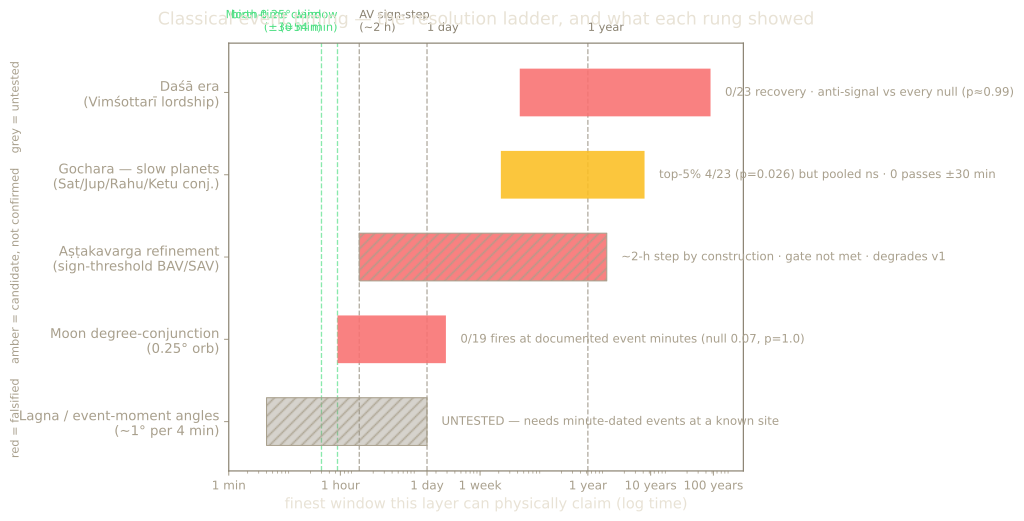
The four layers in one table
| Layer | Physical resolution (best-case) | Evidence | Result | Verdict |
|---|---|---|---|---|
| Daśā era (Vimśottarī lordship) | Years–months | 23 AA lives, 8+ day-dated events each | Engine A: 1/22 out-of-sample at chance; Engine B (likelihood): 0/23, anti-signal p ≈ 0.99; Lahiri cell 0/23 | Falsified at minute recovery; anti-signal under likelihood |
| Raw gochara (slow-planet transits) | 15 days – 60 days (best-case; Stage 1 used ±2° ≈ 120 days) | Same cohort, primary marriage/childbirth/accident set | 0/23 passes ±30 min; top-5% 4/23 (p = 0.026) but pooled p = 0.73 vs age-window null; Lahiri byte-identical | Inconclusive (candidate — not confirmed; underpowered to distinguish null from small effect) |
| Aṣṭakavarga refinement | ~2-h sign step | Same cohort; three arms incl. v1 control (reproduces exactly) | Gate not met on any arm; degrades v1 ranking (mean 17.2 → 45.5); top-5% "hits" are plateau artefacts | Not supported at this resolution; harmful to minute ranking |
| Moon degree-conjunction | ≈54 min (0.25° orb) | 19 independently minute-dated events, 8 AA anchors, double-sourced + audited | 0/19 fires at documented minutes vs null 0.07 — p = 1.0000 at every orb; M-8 sign channel p = 0.90 | Falsified at hour resolution (Stage 2 recovery not entered) |
| Event-moment angles | ~4 min / 1° | Needs minute-dated events at a known site | Not tested — no qualifying evidence class exists in the public record | Untested |
Why the programme kept going after each null
Each layer is a different claim, and each required a different falsification. A failure of daśā–lordship alone says nothing about transits — the tradition's own answer to "when, within the era". A failure of slow-planet gochara says nothing about the hour-level Moon, because slow planets cannot physically resolve hours regardless of evidence quality. And a null at every transit resolution still leaves event-moment angles, the only layer whose motion carries minute structure — untestable until the record supplies events dated to the minute at a known site. The programme therefore ran the classical layers in their own resolution order, and each study was gated: the raw-gochara result was a candidate, not a closure, which justified the Aṣṭakavarga refinement; the refinement failed; the hour-level test then used a strictly stronger evidence class (known charts, documented event minutes, no candidate scan) and still found nothing. The direction of each finding was reported even when it was awkward: raw gochara genuinely ranks recorded times far higher than chance-shaped expectations, which is why it is described as an unresolved candidate rather than folded into the negatives.
What the programme establishes
- The era claim (daśā) fails. On day-granular events from certificate-grade lives, the classical lordship mapping recovers no birth-time signal under either formalisation and prefers wrong times under likelihood — an anti-signal robust to every null constructed, including one that preserves life-course structure.
- The day-level trigger claim (gochara) is unresolved at best. Recorded times rank unusually well (a real qualitative difference from the daśā layer), but zero recover within ±30 minutes and the pooled comparison with chance fails. The classical refinement that is supposed to sharpen it (Aṣṭakavarga) demonstrably blunts it instead.
- The hour-level trigger claim (Moon) fails. At the one transit resolution that can mark an hour, on the strongest evidence the public record provides, documented event minutes show no Moon–significator alignment above chance.
- Ayanāṁśa is a real discriminator. The daśā layer's apparent successes were frame artefacts (Pushya-only; 0/23 under Lahiri); the transit layer is frame-robust by construction. Minute-level daśā claims inherit ~24° of frame uncertainty; angular claims do not.
- Evidence quality is the binding constraint, and it is now documented. Day-dated famous lives are a coarse test bed; minute-dated certificate-grade registries are rare and require multi-round source audits (one AI's entire contribution was rejected as fabricated). The minute-level rung of the ladder awaits a genuinely minute-dated, site-known evidence class — for which this programme has now published the intake standard.
What it does not establish
- Nothing about astrology's non-timing claims.Personality↔chart matching (null across six model families, published here), the lunar-phase market study (published here), and this timing programme are separate falsifications of separate claims.
- Nothing about a skilled human astrologer's holistic reading. These engines test the objective cores of four doctrines as a service would deploy them — not the full art as a practitioner exercises it. A practitioner may read the same evidence with interpretive freedom these engines were denied by design.
- Nothing about the minute-level rung. Event-moment angles remain untested. The honest statement is that no tested layer shows a confirmed positive signal — the daśā, Aṣṭakavarga, and Moon layers are falsified; raw gochara is inconclusive at this power — and that the finest resolvable level (minutes) has not yet been reached by any study in this programme.
- Power limitations. No formal power analysis is reported for any layer. The cohort was sized by availability of AA-grade public-figure records (n = 23 for day-granular; n = 19 events / 8 subjects for hour-dated), not by a target effect size. The raw-gochara pooled p = 0.73 cannot distinguish "no effect" from "underpowered to detect a real effect." Future studies should pre-register a minimum detectable effect size.
- Nothing about the recorded birth times themselves. Einstein's AA anchor failed the daśā method; a method's failure on a sound anchor is evidence against the method as built, not a licence to doubt every certificate.
The four studies
- Daśā: Birth-Time Rectification: A Blinded 23-Subject Backtest — the engine, the falsification battery, the likelihood reframe, and the anchor audit.
- Gochara, Aṣṭakavarga and the Moon: Transits as Event Triggers: A Three-Stage Test — full methods, registry, audit trail and per-stage results.
- Specs, payloads, engines, per-draw arrays and run notes for all four layers live in the study repository under research/ (transit-timing-study/ and birth-time-rectification-study/), each spec committed before its run, every negative published in full.
Study timeline
| Date (2026) | Layer | Outcome |
|---|---|---|
| 09-01 → 09-05 | Daśā era — 13-subject backtest, H1 analysis, timezone audit, 10-subject expansion | Cohort at chance; out-of-sample 1/22; Varga matrix 0/10 on fresh subjects |
| 09-07 | Daśā — falsification battery + likelihood reframe + anchor audit | 0/23; anti-signal p ≈ 0.99 across nulls; Lahiri 0/23; Churchill re-rated A |
| 09-07 | Raw gochara — cohort run + Lahiri cell | Candidate, not confirmed (0 passes; top-5 4/23; pooled p = 0.73) |
| 09-07 | Aṣṭakavarga refinement — three-arm run | Gate not met; degrades v1; hits are plateau artefacts |
| 09-07 | Moon-degree at documented event minutes — registry + audit + run | 0/19 fires, p = 1.0000; M-8 null; hour-level layer closed |
| 09-07 | This synthesis published | Four layers, one ladder; minute-level rung documented as untested |
Published 2026-09-07 by the ATRAC Institute's Sidereal Telemetry Lab. This is scientific research on the measurable claims of a planned service, not a validation of any astrological product. The rectification and transit-timing services remain closed until a protocol-fixed accuracy gate is met.